On Recognition
The Baptism of Christ, Individualism, Vocation
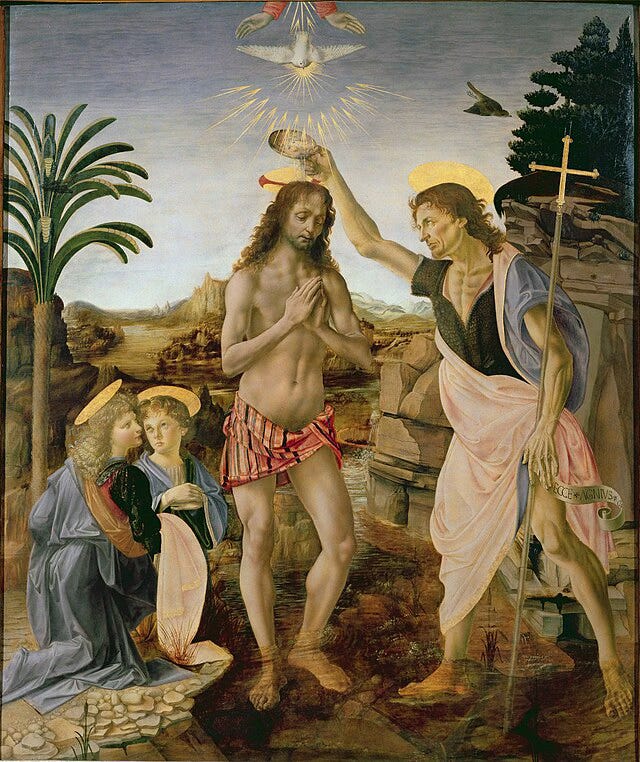
The Baptism of Christ is one of the more confounding episodes of the Gospels. I am not alone in saying this, of course. One of its most significant features is the confusion of John the Baptist that it’s happening at all. Christ’s response to His kinsman’s questioning is evasive enough that we are forced to continue asking what it meant to this day. What follows is a proposal, a reading, though not, of course, the only possible one.
Saint Basil the Great, in one of his homilies (and I am paraphrasing here) suggests, counterintuitively, that the poor do the rest of us a great mercy when they receive our earthly goods. First of all, they do us the great favor of taking some of our money off of our hands, removing the opportunity for us to use it on vices or frivolities. This is a fairly typical point for a Patristic provocation, but it is not the one on which I want to focus here. The second way that the poor do us a mercy is in allowing us to be just to them. By their presence, by their need, they provide the rest of us with the opportunity to make things right, and to offer of ourselves to and for them. Often, we speak of the gratitude expressed by the recipients of our largesse, holding it up as an example of how we ought to be toward God. This is fair enough, but it misses, by this reading, who is the greatest beneficiary of the interaction. By providing them with their material needs, we do them a material service, but by receiving our material goods, they do us a spiritual one. To give out of one’s need, then, is to recognize this priority of the spiritual over ones own physical comfort, and we ought to be grateful to those who allow us to make our belief in that priority real through action.
There has been a stir-up of late over the word “individualism”, with some Christians and even some Catholics going so far as to say that their religion is entirely individual, and that we are saved and brought into relationship with God on our own. I spent most of last year writing to the contrary, so I won’t belabor the point too much, except to say that for Catholics in particular this is utterly nonsensical. Catholicism is a religion of communion, of being brought into a larger corporate body as a mutually dependent and sustaining member. Our baptisms, confirmations, communions, and vocations all make us members of something larger than ourselves, and the sacraments of healing are signs of Christ through His church doing for us what we cannot do for ourselves. The sacramental life is one of the least individualistic things possible, and the fact that we so often treat them as individual activities is a sign of our narcissism and malformation, not something intrinsic to the acts themselves. We do not and cannot enter into Heaven alone, because when we enter Heaven, God willing, we do so as part of the Body of Christ, participating as members in Christ in the triune community. St Robert Bellarmine tells us that at our particular judgement, “the entire syllabus will be love”. The nuptial blessing at a Catholic wedding prays that those who have known the couple’s mercy and hospitality would welcome them into heaven. It is not simply that we cannot arrive in Heaven alone, it is that we cannot get there without the help of others, we need them there for us to love. This is why the martyrs do not hate their murderers, why their final words are never anger. They recognize, on a level the rest of us cannot know, that even this final opportunity to love is a gift, as painful as it may be.
Of course, there are plenty of opportunities to love before such an extreme point, and that is where most of us are tested on a day-to-day level. Pope Leo in Dilexi Te notes something that I have noted several times in this space (though it is certainly not original to either of us): that Christ’s promise to be with us and his assurance that the poor will be with us always are not separate. Rather, since whatever we do to them He receives as done to Him, their presences are identical. Thus, our ability to love Christ is to recognize Him as John the Baptist does, in His condescension to need, His generous willingness to allow us to meet His needs. Our response to this generosity ought to be awe, just as John’s was, that the Lord has come and by coming He allows us to be what we were always meant to be. Christ did not need to be baptized, but John needed to baptize Him. Christ does not need us to feed Him in the hungry, to visit Him in the prisoner, to welcome Him in the immigrant, but we need to do so, or we are less than what we were made to be, less than fully human.
The Baptism of Christ, then, is an example for us of receptivity to and recognition of Christ as He comes to us in unexpected ways and asks for us to do unexpected things. We spent the last month and a half, roughly, in expectation and then celebration of His arrival as a poor infant. Now, lest we get too comfortable with him in the manger, we leap forward to His unpredictable, extraordinary arrivals as we go about our day to day practices of our faith and our lives. We have spent the last period preparing to see Him in one way, and He shows up in another. May we be attentive to His arrivals every day of our lives, and learn to be grateful for the opportunities he offers in the inconveniences He brings and demands He makes.
Please consider subscribing at the provided button below. Subscriptions are free and I have no intent to monetize any time soon, but I would like to encourage you to donate (recurrently, if you can) to one of many charities and organizations that serve the poor and marginalized, particularly immigrants. What we do to our brothers and sisters is done to Christ, for good and for evil. May God bless and keep you all.
Excellent reflection