Love, Hate, Self
Revisiting The Scapegoat
It’s a cliche (one might even say common sense) that “nothing brings people together like a common enemy”. It is my sense that this has become something of an organizing principle for society, though I suppose one could contest that it had to “become” such. In any case, it is certainly true that the identification and punishment of an outgroup or other is the “peace” for which most of us are happy to settle. “I can get along just fine” we say, “with anyone who hates (that guy/those people)”.
I don’t think I need to say that this is the spirit of Anti-Christ. Those who read this page are likely to agree, and those who disagree are unlikely to be bothered by my opinion. That said, I think there are some interesting (and possibly revelatory) ways that such an approach to “peace” harms the mind and soul, and that examining these harms will allow us to be cognizant of the habits of thought which lead us away from the two great commandments of loving God and Neighbor.
I have been reading some of Byung-Chul Han’s essays recently, and one of his major concerns is that our approach to love, defined broadly, reduces the other/beloved to an object to be consumed. We have become in some ways essentially consumers, for him, and broadly unable to enter into the self-emptying that genuine love entails. The beloved is taken into ourselves, we do not give ourselves over.
This put me in mind, again, of Bishop Erik Varden’s excellent book on Chastity, a virtue which starts from the proper understanding of the boundaries between the self and the other. Thought of in this way, unchastity in the popular usage mingles with unchastities we mostly would not think of as such, like parents treating their children as an extension of the self. Failures of love in general can be thought of as a failure to recognize the other, however we find them, as an other, rather than as a method of self-extension, an object to be used or consumed, or a scapegoat, as mentioned before.
In fact, I believe this sheds an interesting new light on the scapegoat mechanism itself. The creation and punishment of a common enemy does not bring unlike others together as others, it generates the shallowest kind of identification-with. It is a paltry form of self-extension. “I hate (person/group), and thus anyone who joins me in hating them has membership in me”. It is a perfect inversion of Christ’s command to love God and Neighbor in order to gain membership in Him, and specifically membership in Him within the Trinitarian act of self-emptying gift.
I think in times like ours, as we cast about for someone to blame for our condition, it is easy to settle for the false peace of shared hatred. We may not be able to make the world an easy one in which to be good, but we can at least blame those who thwart us, and joining me in that hatred is accepted as a substitute for the collaborative work of building that sort of world. “God’s will is not done on earth, but that’s hardly my problem”.
I’ve written before about our ability to handwave our hatreds, and while I still hold that to be true I also think we are broadly aware of the state of our hearts. We know, deep down, when we are hateful, no matter how much we call it love, or “righteous”, or justified. The damage done to our souls remains the same.
However, as with any vice, I don’t think that the war against our own hatefulness and self-interest begins by avoiding the habits of thought and feeling that result in our hateful act. The repression of these habits, I think, results only in a lower-temperature resentment of those whom we would really like to hate. Trying not to hate our “enemies” is not enough for the Christian. Rather, we must learn to love. We must become capable of self-emptying love for an Other, and the less “natural”, the more difficult, the better. Our love is purified and Christ-like when we love an Other with whom we have no reason to identify, even to the point that we are willing to die for them.
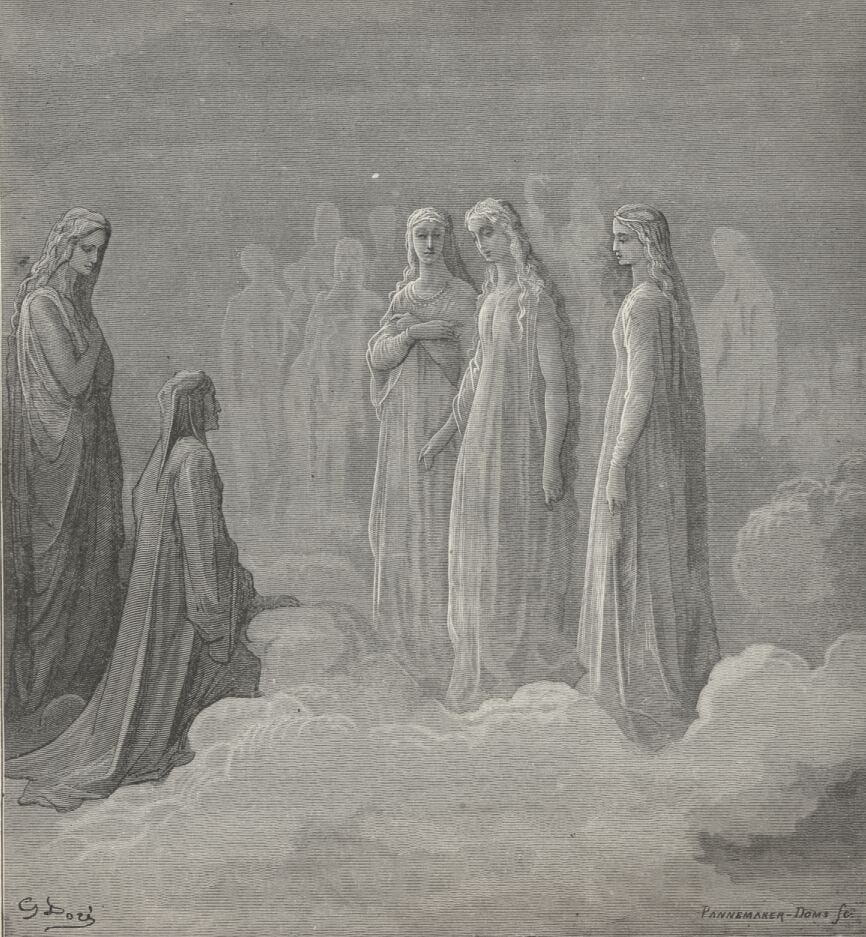
In Dante’s Paradiso, he is greeted by a number of Saints in heaven with the phrase “here comes one who will increase our loves”. A new other, a new image-bearer, is a chance for the sanctified to learn to love new aspects of the image. As the Catechism says in paragraph 1946, “The differences among persons belong to God's plan, who wills that we should need one another. These differences should encourage charity.” Our difference is a call to love and an opportunity to love more. To love only that which belongs to us, and those with whom we identify racially, culturally, politically, linguistically, geographically, or along any other qualifier is a rejection of God’s command. It is to be less than what we were made to be, less than human.
St. Robert Bellarmine said it better than I can, “The school of Christ is the school of love. In the last day, when the final examination takes place… Love will be the whole syllabus”.
Please consider subscribing at the provided button below. Subscriptions are free and I have no intent to monetize any time soon, but I would like to encourage you to donate (recurrently, if you can) to one of the many charities that serve the poor and are now going without our support. What we do to our brothers and sisters is done to Christ, for good and for evil. May God bless and keep you all.